


In k nearest neighbors, the shape of the neighborhood is usually circular. Discriminant Adaptive Nearest Neighbors (dann) is a variation of k nearest neighbors where the shape of the neighborhood is data driven. The neighborhood is elongated along class boundaries and shrunk in the orthogonal direction. See Discriminant Adaptive Nearest Neighbor Classification by Hastie and Tibshirani.
This package brings the dann package into the
tidymodels ecosystem. Both models share a single model specification,
nearest_neighbor_adaptive(), and are selected by
engine:
nearest_neighbor_adaptive() with engine
dann.nearest_neighbor_adaptive() with engine
sub_dann.Calculations are done in C++ with RcppArmadillo. If R is built with OpenMP support, they are multithreaded.
In this example, data is simulated. The overall trend is a circle inside a square.
library(parsnip)
library(rsample)
library(scales)
library(dials)
library(tune)
library(yardstick)
library(workflows)
library(tidydann)
library(dplyr, warn.conflicts = FALSE)
library(ggplot2)
library(mlbench)

# Create training data
set.seed(1)
circle_data <- mlbench.circle(700, 2) |>
  tibble::as_tibble()
colnames(circle_data) <- c("X1", "X2", "Y")

set.seed(42)
split <- initial_split(circle_data, prop = .80)
train <- training(split)
test <- testing(split)

ggplot(train, aes(x = X1, y = X2, colour = as.factor(Y))) +
  geom_point() +
  labs(title = "Train Data", colour = "Y")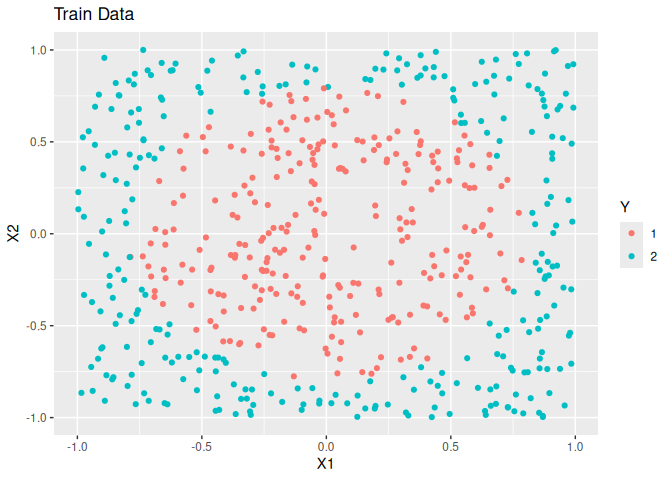
AUC is nearly perfect for these data.
model <- nearest_neighbor_adaptive(neighbors = 5, neighborhood = 50, matrix_diagonal = 1) |>
  set_engine("dann") |>
  fit(formula = Y ~ X1 + X2, data = train)

testPredictions <- model |>
  predict(new_data = test, type = "prob")
testPredictions <- test |>
  select(Y) |>
  bind_cols(testPredictions)

testPredictions |>
  roc_auc(truth = Y, event_level = "first", .pred_1)
#> # A tibble: 1 × 3
#>   .metric .estimator .estimate
#>   <chr>   <chr>          <dbl>
#> 1 roc_auc binary 0.987In general, dann struggles as unrelated variables are intermingled with informative ones. To deal with this, sub_dann projects the data onto a lower dimensional subspace and then calls dann on that subspace. In this example, there are 2 informative variables and 5 that are not informative.
######################
# Circle data with unrelated variables
######################
# Create training data
set.seed(1)
circle_data <- mlbench.circle(700, 2) |>
  tibble::as_tibble()
colnames(circle_data) <- c("X1", "X2", "Y")

# Add 5 unrelated variables
circle_data <- circle_data |>
  mutate(
    U1 = runif(700, -1, 1),
    U2 = runif(700, -1, 1),
    U3 = runif(700, -1, 1),
    U4 = runif(700, -1, 1),
    U5 = runif(700, -1, 1)
  )

set.seed(42)
split <- initial_split(circle_data, prop = .80)
train <- training(split)
test <- testing(split)
Without careful feature selection, dann’s performance suffers. AUC dropped from .987 to .850 on the test set.
model <- nearest_neighbor_adaptive(neighbors = 5, neighborhood = 50, matrix_diagonal = 1) |>
  set_engine("dann") |>
  fit(formula = Y ~ ., data = train)

testPredictions <- model |>
  predict(new_data = test, type = "prob")
testPredictions <- test |>
  select(Y) |>
  bind_cols(testPredictions)

testPredictions |>
  roc_auc(truth = Y, event_level = "first", .pred_1)
#> # A tibble: 1 × 3
#>   .metric .estimator .estimate
#>   <chr>   <chr>          <dbl>
#> 1 roc_auc binary         0.850
To deal with the uninformative variables, a sub_dann model with tuned parameters is trained. The tidydann package provides a few parameters that can be tuned. Two of them have to be finalized based on data.
# define grid. neighborhood is capped relative to the fold size below.
set.seed(2)

finalized_neighborhood <- neighborhood() |> get_n_frac(train, frac = .20)
finalized_num_comp <- num_comp() |> get_p(train |> select(-Y))

grid <- grid_random(
  neighbors(),
  finalized_neighborhood,
  matrix_diagonal(),
  weighted(),
  sphere(),
  finalized_num_comp,
  size = 30,
  filter = neighbors <= neighborhood
)
Next a workflow is defined.
# define workflow
sub_dann_spec <-
  nearest_neighbor_adaptive(
    neighbors = tune(),
    neighborhood = tune(),
    matrix_diagonal = tune(),
    weighted = tune(),
    sphere = tune(),
    num_comp = tune()
  ) |>
  set_engine("sub_dann") |>
  set_mode("classification")

sub_dann_wf <- workflow() |>
  add_model(sub_dann_spec) |>
  add_formula(Y ~ .)
Lastly, 5 fold cross validation is done using the workflow and grid defined above. The best model according to AUC is selected.
# tune
set.seed(123)
cv <- vfold_cv(data = train, v = 5)
sub_dann_tune_res <- sub_dann_wf |>
  tune_grid(resamples = cv, grid = grid)
best_model <- sub_dann_tune_res |>
  select_best(metric = "roc_auc")
With the best hyperparameters found, a final model is fit on all the training data. Test AUC improved.
# retrain on all training data
final_model <-
  sub_dann_wf |>
  finalize_workflow(best_model) |>
  last_fit(split)

final_model |>
  collect_metrics() |>
  filter(.metric == "roc_auc") |>
  select(.metric, .estimator, .estimate)
#> # A tibble: 1 × 3
#>   .metric .estimator .estimate
#>   <chr>   <chr>          <dbl>
#> 1 roc_auc binary         0.985